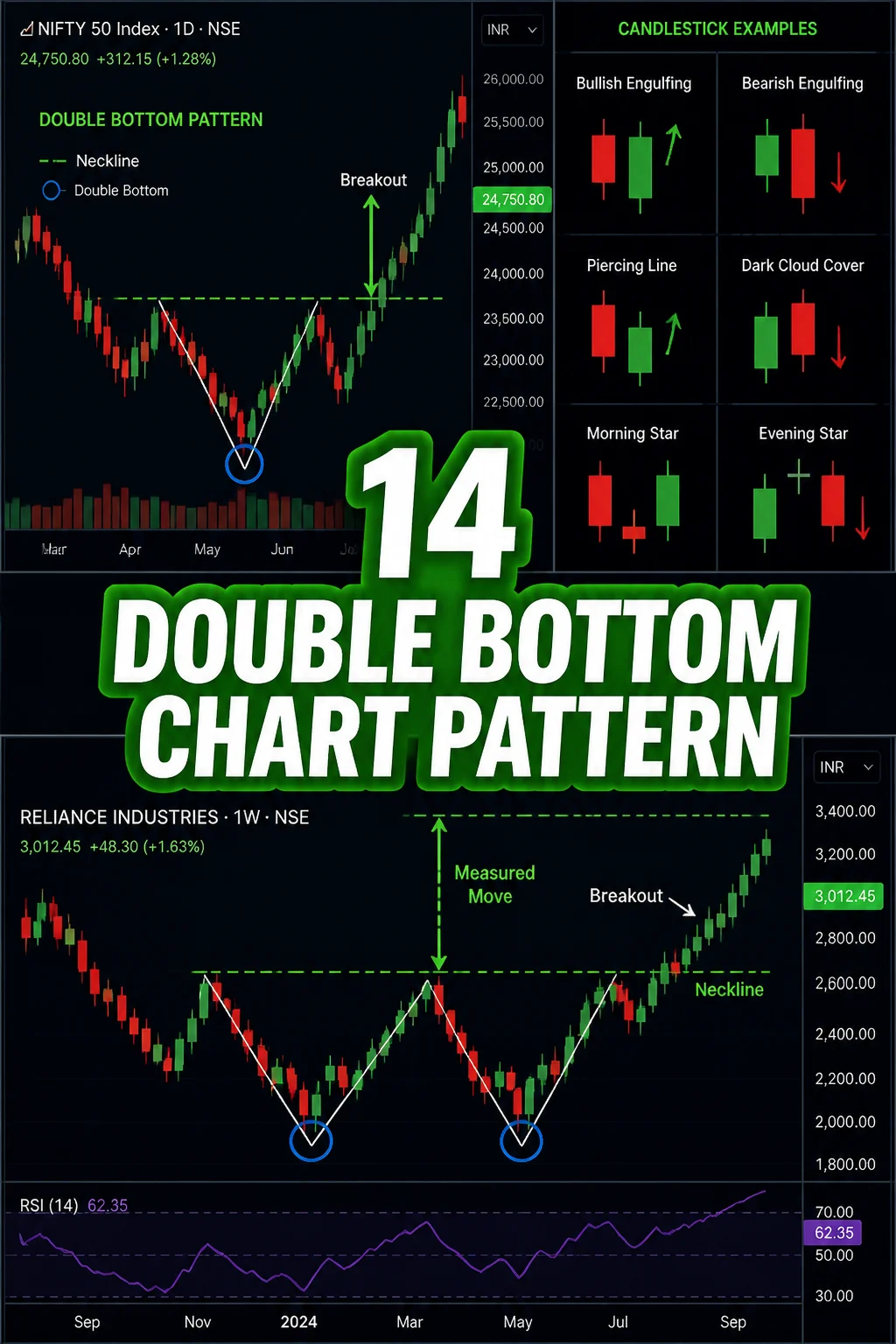
📈 14 Double Bottom Chart Pattern
📚 The Financial Literacy Library
The best investment you can ever make is in your own financial education. These 5 cornerstone books are what millionaires, financial advisors, and wealth-builders universally recommend for completely rewiring how you think about earning, saving, and investing money.
🧠 The Psychology of Money
Doing well with money isn't necessarily about what you know—it's about how you behave. Morgan Housel masterfully breaks down the emotional and psychological biases that secretly dictate our financial decisions, offering a true paradigm shift in how to view wealth.
🏠 Rich Dad Poor Dad
The #1 personal finance book of all time for a reason. This foundational read shatters the myth that you need to earn a high income to be rich, teaching you the critical difference between working for money and making your money work for you via assets.
📈 Atomic Habits
While not strictly a finance book, building wealth is absolutely dependent on the daily habits you cultivate. James Clear provides the definitive framework for breaking bad spending habits and effortlessly automating the good ones that lead to long-term success.
📊 The Simple Path to Wealth
The ultimate antidote to complex, intimidating financial advice. JL Collins provides an incredibly accessible, low-stress roadmap to financial independence through index fund investing, perfectly explaining why simplicity beats Wall Street complexity every time.
💳 I Will Teach You to Be Rich
A tactical, no-BS, 6-week program that actually works. Ramit Sethi teaches you how to crush debt, automate your savings, and negotiate your salary—all while guilt-free spending on the things you truly love. A must-read for modern money management.
Alright trendsetters, ever feel like the market is giving you a secret wink, hinting at something big about to happen? Well, sometimes it totally is, and today we’re spilling the tea on one of its most reliable signals: the Double Bottom Chart Pattern. Forget your basic up-and-down; this bad boy is a reversal rockstar, signaling a downtrend might just be throwing in the towel. If you’re ready to spot potential comebacks before everyone else, keep scrolling. We’re breaking down everything you need to know, no boring textbooks allowed.
1. What It Is
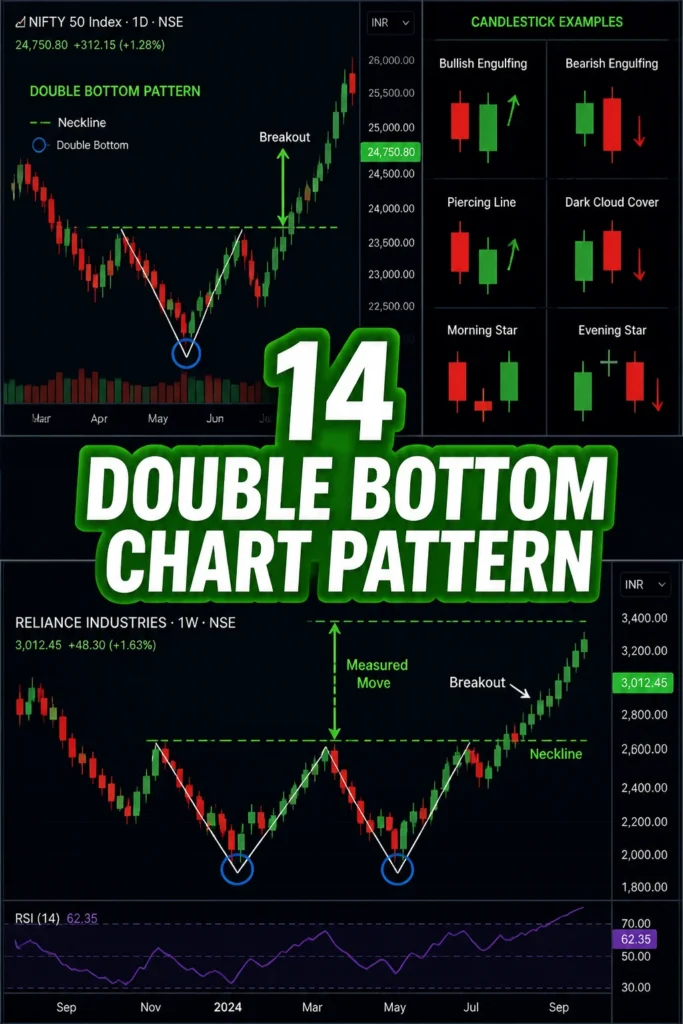
Ever spot a ‘W’ on your charts that wasn’t just alphabet soup? The Double Bottom Chart Pattern is a classic reversal signal. It pops up after a downtrend, hinting that the bears might be taking a much-needed nap, and the bulls are about to hit the gym. Think of it as the market trying to find its footing twice before deciding to climb. It’s basically a “nope, not going lower” signal.
2. The ‘W’ Shape
Visually, this pattern is a total show-off, flaunting a distinct ‘W’ shape. You’ll see two distinct troughs (the bottoms) at roughly the same price level, separated by a peak (the neckline). It’s like the market is doing a little dip, then a bounce, then another dip, then hopefully a rocket launch. If it looks more like a squiggly line than a clear ‘W’, maybe hold off. Clarity is your friend. When you spot that ‘W’, your trend-reversal radar should be pinging.
3. First Bottom
So, the price drops, hits a low, and then bounces a bit. That’s your first bottom. This initial dip indicates that sellers are still in control, but maybe, just maybe, some buyers are starting to nibble. It’s the market’s first attempt to find a floor. Don’t get too excited yet; this could just be a temporary pause in the downtrend. Consider it the warm-up act, not the main event.
4. Bounce Back
After that first low, prices usually rebound a bit, forming a peak. This is crucial. This mini-rally shows that buyers have enough oomph to push prices up, at least temporarily. It forms the middle leg of our ‘W’ and sets up the all-important neckline. A stronger bounce here often suggests more underlying buying interest. This rebound confirms there’s some fight left in the market.
5. Second Bottom
Here’s where the plot thickens. The price drops again, ideally hitting around the same level as the first bottom. This retest of the previous low is the market’s ultimate test. If it holds, it screams that the sellers are losing their grip and can’t push prices lower. It’s the real deal for confirming support. Watch for divergences here, especially with indicators like RSI, which can offer extra confirmation. This second dip holding firm is the pattern’s secret sauce.
6. Neckline Breakout
This is your green light, your “go time” signal. The neckline is the highest point between the two bottoms. A confirmed breakout happens when the price decisively closes above this level. This move signals that buyers have finally overpowered sellers. Always wait for a clear close above the neckline, not just a quick wick. Patience pays. No breakout, no party. It’s that simple.
7. Volume Confirmation
Price moves are cool, but volume tells the real story. For a robust double bottom, you want to see volume surge on the breakout above the neckline. Low volume on the second bottom and then increasing volume on the rally and breakout adds serious credibility to the pattern. Think of volume as the crowd cheering; louder cheers mean more conviction. Without volume, even a perfect ‘W’ might just be a mirage.
8. Target Price
So, you’re in. Now what? Let’s talk potential gains. A common way to estimate the target price is to measure the distance from the bottoms to the neckline. Then, project that distance upwards from the breakout point. It’s not magic, but it’s a good guide. Use this target as a general guide, but always manage your risk and take profits along the way. It gives you a roadmap, not a crystal ball.
9. Entry Points
Timing is everything, right? The most common entry is on the breakout above the neckline. Some aggressive traders might enter on the second bottom with tight stops, but that’s playing with fire. A retest of the neckline after breakout can also offer a solid entry. Consider splitting your entry – a portion on breakout, another on a successful retest. Don’t chase; wait for your moment.
10. Stop Loss Placement
Gotta protect those gains, or at least minimize the pain. A smart move is to place your stop loss just below the second bottom. If the price goes lower than that, the pattern is likely invalidated, and you need to get out. No shame in admitting defeat early. Never trade without a stop loss; it’s your financial seatbelt. Protect your capital like it’s the last slice of pizza.
11. Timeframe Flexibility
Good news, this pattern isn’t a one-trick pony. The double bottom works across various timeframes, from daily charts for swing trading to hourly charts for day trading. The principles remain the same, just the speed of the action changes. Confirm the pattern on a higher timeframe for added conviction, even if you’re trading on a lower one. Adaptability is its middle name.
12. Psychology Behind It
What’s the market really thinking? The first bottom shows sellers dominating, but encountering support. The bounce is buyers testing their strength. The second bottom is sellers trying one last push, failing, and then buyers taking control decisively. It’s a battle of wills. Understanding the psychology helps you anticipate moves, not just react to them. It’s a story of market capitulation and reversal.
13. Not Always Perfect
Let’s be real, nothing’s perfect in this wild market. False breakouts happen. Sometimes a “W” forms, but then the price just tanks again. That’s why confirmation (volume, strong close) and a stop loss are non-negotiable. Don’t fall in love with a pattern; be ready to ditch it if it doesn’t play out. Expect the best, prepare for the worst.
14. Confirmation is Key
We’ve said it before, but it bears repeating. Never, ever jump the gun. Wait for the neckline breakout, ideally with strong volume. Don’t assume a “W” is forming just because you see two dips. The market loves to fake people out. Use other indicators (RSI, MACD) to confirm the bullish momentum after the breakout. Patience isn’t just a virtue; it’s your superpower here.
💼 The Money Management Toolkit
Knowledge is power, but proper execution requires the right tools. Getting your financial life organized doesn't have to be overwhelming. These 5 physical management tools are exactly what successful households use to budget, track cash, and secure their most important assets.
📝 Clever Fox Budget Planner & Bill Organizer
The ultimate analog command center for your finances. Sometimes keeping your budget in an app just doesn't stick. Physically writing down your goals, tracking expenses, and planning for debt payoff creates a level of accountability that digital spreadsheets simply can't match.
💵 A6 Leather Cash Stuffing Binder
The viral tool that made the cash-envelope budgeting system popular again. By allocating actual physical cash to designated envelopes (groceries, dining out, fun money), you physically cap your spending, making it virtually impossible to overdraft or overspend.
🔥 Fireproof & Waterproof Document Safe
A critical piece of financial security that many families overlook. Protecting your passports, birth certificates, property deeds, and estate planning documents from disaster is just as important as protecting the money in your bank account.
🏷️ Brother P-Touch Digital Label Maker
The unsung hero of a functional home office. When tax season rolls around or you need to find an important receipt, having perfectly labeled and categorized filing cabinets or accordion folders saves hours of frustrating searches and potential late fees.
🔒 SentrySafe Compact Fireproof Lock Box
For the physical assets that need extra heavy-duty protection—think emergency cash reserves, hard drives with Bitcoin cold wallets, or physical precious metals. This compact, locking safe provides peace of mind that your physical wealth is secure at home.
Conclusion
So there you have it, your crash course in spotting the Double Bottom Chart Pattern. It’s like finding a hidden gem in a sea of noise, a powerful signal that tells you a comeback story is brewing. Master this ‘W’ and you’re not just watching the market; you’re understanding its vibe, ready to ride those reversals like a pro. Go forth and spot those bottoms, you savvy market whisperer!