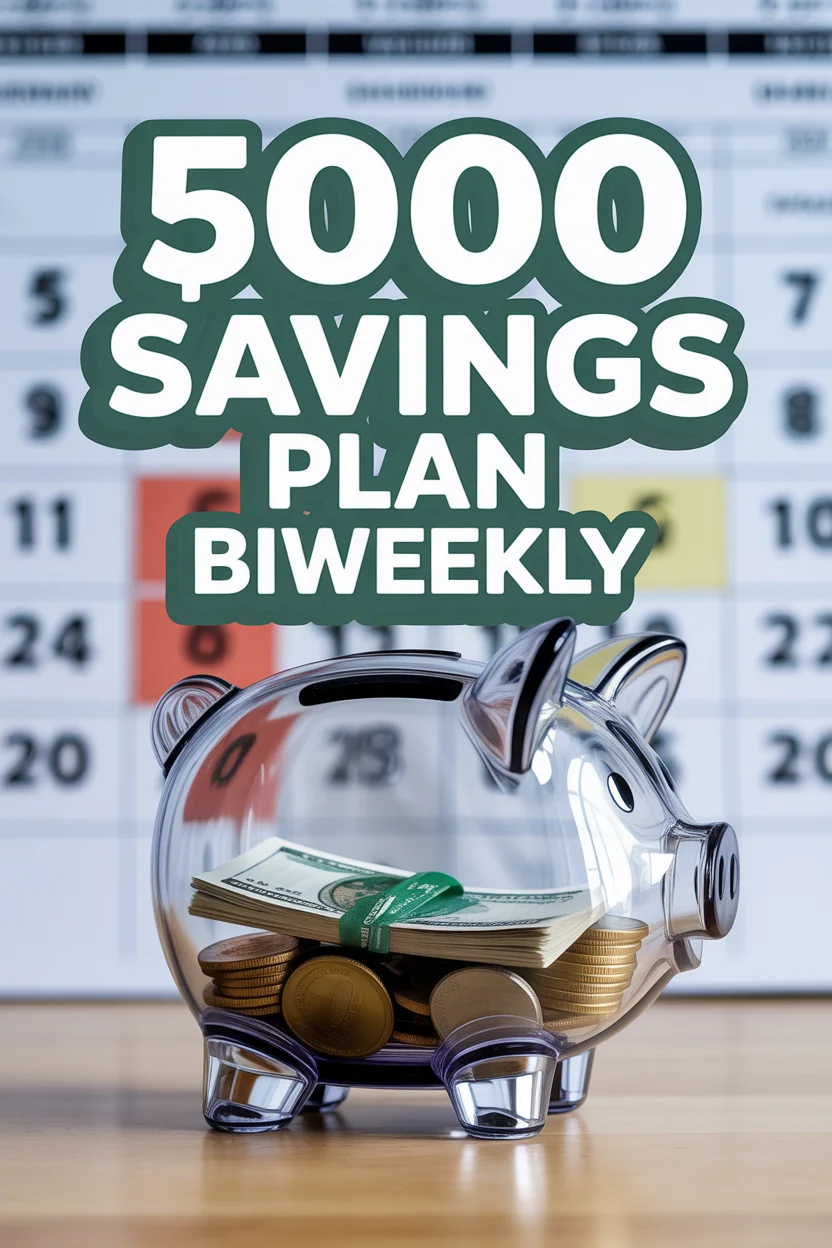
💰 5000 Savings Plan Biweekly
📚 The Financial Literacy Library
The best investment you can ever make is in your own financial education. These 5 cornerstone books are what millionaires, financial advisors, and wealth-builders universally recommend for completely rewiring how you think about earning, saving, and investing money.
🧠 The Psychology of Money
Doing well with money isn't necessarily about what you know—it's about how you behave. Morgan Housel masterfully breaks down the emotional and psychological biases that secretly dictate our financial decisions, offering a true paradigm shift in how to view wealth.
🏠 Rich Dad Poor Dad
The #1 personal finance book of all time for a reason. This foundational read shatters the myth that you need to earn a high income to be rich, teaching you the critical difference between working for money and making your money work for you via assets.
📈 Atomic Habits
While not strictly a finance book, building wealth is absolutely dependent on the daily habits you cultivate. James Clear provides the definitive framework for breaking bad spending habits and effortlessly automating the good ones that lead to long-term success.
📊 The Simple Path to Wealth
The ultimate antidote to complex, intimidating financial advice. JL Collins provides an incredibly accessible, low-stress roadmap to financial independence through index fund investing, perfectly explaining why simplicity beats Wall Street complexity every time.
💳 I Will Teach You to Be Rich
A tactical, no-BS, 6-week program that actually works. Ramit Sethi teaches you how to crush debt, automate your savings, and negotiate your salary—all while guilt-free spending on the things you truly love. A must-read for modern money management.
Have you ever looked at your bank account at the end of the month and wondered where all your hard-earned money went? You aren’t alone. For many of us, the idea of saving a significant lump sum—like $5,000—feels like a mountain that is simply too steep to climb. We tell ourselves, “I’ll start saving when I get that raise,” or “I’ll start next year.” But the secret to building real wealth isn’t about waiting for a windfall; it’s about the power of small, consistent actions.
Enter the 5000 Savings Plan Biweekly. This strategy is designed to take the intimidation factor out of saving. By aligning your savings goals with your paycheck cycle, you transform a daunting $5,000 objective into manageable, bite-sized pieces. Whether you are saving for an emergency fund, a dream vacation, a down payment, or simply the peace of mind that comes with a financial cushion, this plan is your roadmap to success. In this guide, we are going to break down exactly how this plan works, why it is so effective, and the “money-smart” habits you need to adopt to cross the finish line.
What is 5000 Savings Plan Biweekly?
At its core, the 5000 Savings Plan Biweekly is a structured financial challenge aimed at saving $5,000 over the course of one year (52 weeks) by making contributions every two weeks. Since most employers pay on a biweekly schedule, this plan aligns perfectly with the rhythm of your income. There are 26 biweekly pay periods in a standard year. When you divide $5,000 by 26, you get a target of approximately $192.31 per paycheck.
The beauty of this plan lies in its simplicity and its psychological design. Most people struggle to save because they try to save “whatever is left over” at the end of the month. Usually, what’s left over is zero. By using a biweekly plan, you shift your mindset to “paying yourself first.” You treat your savings like a non-negotiable bill that must be paid every time you receive your salary.
This plan is also highly adaptable. While the mathematical average is $192.31, some people prefer a “fluctuating” model where they save smaller amounts during expensive months (like December) and larger amounts during months where they have three paychecks (which happens twice a year for biweekly earners). Regardless of the specific cadence, the goal remains the same: hitting that $5,000 milestone through disciplined, biweekly contributions.
Key Features
Why has the 5000 Savings Plan Biweekly become such a popular trend in the personal finance community? It’s because it addresses the common pitfalls of traditional budgeting. Here are the key features that make this plan a powerhouse for wealth building:
- Paycheck Alignment: Most people budget based on when they get paid. By setting a biweekly goal, the money moves from your checking account to your savings account before you even have a chance to miss it.
- The “Magic” Third Paycheck: In a biweekly pay cycle, there are two months every year where you receive three paychecks instead of two. These “extra” checks are a golden opportunity to get ahead of your goal without feeling the pinch in your monthly budget.
- Psychological Momentum: Saving $200 feels much more achievable than saving $5,000. Each biweekly contribution provides a “micro-win” that boosts your confidence and keeps you motivated to continue.
- Compound Interest Potential: When you save consistently in a High-Yield Savings Account (HYSA), your money starts working for you. While $5,000 is your contribution goal, the interest earned over the year means you’ll actually end up with more than $5,000 in the bank.
- Flexibility: This plan isn’t a “one size fits all” straightjacket. You can adjust the amounts based on your lifestyle, as long as the total at the end of the 26 periods equals your goal.
How to Get Started
Ready to take the plunge? Transitioning from “thinking about saving” to “actually saving” requires a bit of preparation. Follow these practical steps to kick off your 5000 Savings Plan Biweekly today.
1. Conduct a Financial Audit
Before you can commit $192.31 every two weeks, you need to know where your money is currently going. Look at your bank statements from the last three months. Categorize your spending into “Needs” (rent, utilities, groceries) and “Wants” (dining out, streaming services, impulse buys). Identify at least $200 worth of “Wants” that you can redirect toward your savings goal.
2. Choose the Right Account
Do not keep your savings in your everyday checking account. It is too easy to spend it by accident. Open a dedicated High-Yield Savings Account (HYSA). These accounts currently offer significantly higher interest rates than traditional big-bank savings accounts. Look for an account with no monthly fees and an easy-to-use mobile app.
3. Automate the Process
Automation is the “cheat code” of personal finance. Set up an automatic transfer from your checking account to your HYSA to trigger on every payday. If you never see the money in your checking account, you won’t feel the “loss” of it. This removes the need for willpower, which is a finite resource.
4. Use a Visual Tracker
There is something incredibly satisfying about checking off a box or filling in a progress bar. Create or download a “52-Week/26-Paycheck” savings tracker. Post it on your fridge or keep it in your planner. Every time you hit your biweekly goal, mark it off. This visual representation of your success will keep you focused when you’re tempted to splurge.
5. Prepare for the “Tight” Weeks
Life happens. There will be weeks where an unexpected car repair or a friend’s wedding threatens your savings goal. Instead of skipping the contribution entirely, try to save a smaller amount—even $50—to keep the habit alive. You can make up the difference during your “three-paycheck” months.
Tips for Success
Hitting a $5,000 goal requires more than just math; it requires a shift in your daily habits. Here are some pro-tips to help you stay on track and perhaps even reach your goal faster.
Master the “72-Hour Rule”
Impulse spending is the enemy of the 5000 Savings Plan Biweekly. Whenever you feel the urge to buy something that isn’t a necessity, wait 72 hours. Often, the “must-have” feeling fades, and you’ll realize you’d rather have that money in your savings account. This simple hack can save you hundreds of dollars over the course of a year.
Audit Your Subscriptions
We live in a subscription economy. From streaming services to “box of the month” clubs, these small $10-$20 charges add up quickly. Use an app or manually go through your statements to cancel anything you haven’t used in the last 30 days. Redirecting just two unused subscriptions can cover 20% of your biweekly savings goal.
The “Half-Windfall” Strategy
Throughout the year, you might receive “windfalls”—unexpected money like tax refunds, birthday gifts, or work bonuses. Instead of spending the whole amount, apply the “Half-Windfall” rule: save 50% toward your $5,000 goal and spend the other 50% on something you enjoy. This allows you to accelerate your progress without feeling deprived.
Gamify Your Groceries
Groceries are one of the largest variable expenses in a household budget. Challenge yourself to a “pantry week” once a month where you only buy perishables (like milk and eggs) and cook meals using what you already have in your cabinets. The money you save on that week’s grocery bill can go directly into your biweekly savings pot.
Common Mistakes to Avoid
Even the most well-intentioned savers can get tripped up. Avoid these common pitfalls to ensure your 5000 Savings Plan Biweekly stays on the rails.
1. Neglecting Your Emergency Fund: If you don’t have at least $1,000 set aside for emergencies, a flat tire or a broken tooth will force you to dip into your $5,000 savings. Build a small “starter” emergency fund first, then start the 5000 plan.
2. The “All or Nothing” Mindset: Many people give up on their savings plan the moment they miss one contribution. If you have a bad month, don’t throw in the towel. Just pick up where you left off. Saving $3,000 is still infinitely better than saving $0 because you gave up.
3. Keeping Savings Too Accessible: If your savings account is linked to your debit card, the temptation to “borrow” from yourself will be constant. Consider opening your HYSA at a different bank than your primary checking account. The 1-2 days it takes to transfer money back will act as a “speed bump” against impulsive spending.
4. Ignoring Small Wins: Don’t wait until you hit $5,000 to celebrate. Celebrate when you hit $1,000, $2,500, and $4,000. Recognizing your progress keeps your motivation high for the long haul.
FAQ
What if I can’t afford $192.31 every two weeks?
Don’t panic! The 5000 Savings Plan Biweekly is a goal, not a law. If $192 is too high, start with $50 or $100. The most important part is establishing the habit of biweekly saving. As you cut expenses or increase your income, you can “ramp up” your contributions to meet the $5,000 target.
Should I save $5,000 if I have high-interest credit card debt?
Generally, it is money-smart to pay off high-interest debt (anything over 7-8% interest) before aggressively saving. However, having a small cushion is vital. Consider saving a $1,000-$2,000 “mini” fund while aggressively paying down debt, then switch to the 5000 plan once your high-interest balances are gone.
Is $5,000 enough for an emergency fund?
For many individuals, $5,000 is a fantastic starting point. It covers most minor to moderate emergencies. However, financial experts usually recommend having 3-6 months of living expenses saved. Use this plan as a stepping stone to your ultimate long-term stability goal.
Can I do this plan if I am paid weekly or monthly?
Absolutely. If you are paid weekly, your goal is about $96.15 per week. If you are paid monthly, your goal is $416.67 per month. The biweekly structure is popular because it matches the most common pay cycle, but the math works for any frequency!
💼 The Money Management Toolkit
Knowledge is power, but proper execution requires the right tools. Getting your financial life organized doesn't have to be overwhelming. These 5 physical management tools are exactly what successful households use to budget, track cash, and secure their most important assets.
📝 Clever Fox Budget Planner & Bill Organizer
The ultimate analog command center for your finances. Sometimes keeping your budget in an app just doesn't stick. Physically writing down your goals, tracking expenses, and planning for debt payoff creates a level of accountability that digital spreadsheets simply can't match.
💵 A6 Leather Cash Stuffing Binder
The viral tool that made the cash-envelope budgeting system popular again. By allocating actual physical cash to designated envelopes (groceries, dining out, fun money), you physically cap your spending, making it virtually impossible to overdraft or overspend.
🔥 Fireproof & Waterproof Document Safe
A critical piece of financial security that many families overlook. Protecting your passports, birth certificates, property deeds, and estate planning documents from disaster is just as important as protecting the money in your bank account.
🏷️ Brother P-Touch Digital Label Maker
The unsung hero of a functional home office. When tax season rolls around or you need to find an important receipt, having perfectly labeled and categorized filing cabinets or accordion folders saves hours of frustrating searches and potential late fees.
🔒 SentrySafe Compact Fireproof Lock Box
For the physical assets that need extra heavy-duty protection—think emergency cash reserves, hard drives with Bitcoin cold wallets, or physical precious metals. This compact, locking safe provides peace of mind that your physical wealth is secure at home.
Conclusion
The 5000 Savings Plan Biweekly is more than just a way to stack cash; it is a masterclass in financial discipline. By breaking down a significant goal into manageable biweekly payments, you are training your brain to prioritize your future self over temporary impulses. Imagine how it will feel a year from now when you log into your bank account and see a 5,000-dollar balance staring back at you. That money represents freedom, security, and the proof that you have the power to control your financial destiny.
Remember, the best time to start was yesterday; the second best time is today. Don’t wait for the “perfect” moment to begin your wealth-building journey. Open that high-yield account, set up your first automation, and take that first step toward your $5,000 goal. You’ve got the plan, you’ve got the tips, and you certainly have the potential. Now, go make it happen!