💰 How To Save 4000 In 6 Months Chart
📚 The Financial Literacy Library
The best investment you can ever make is in your own financial education. These 5 cornerstone books are what millionaires, financial advisors, and wealth-builders universally recommend for completely rewiring how you think about earning, saving, and investing money.
🧠 The Psychology of Money
Doing well with money isn't necessarily about what you know—it's about how you behave. Morgan Housel masterfully breaks down the emotional and psychological biases that secretly dictate our financial decisions, offering a true paradigm shift in how to view wealth.
🏠 Rich Dad Poor Dad
The #1 personal finance book of all time for a reason. This foundational read shatters the myth that you need to earn a high income to be rich, teaching you the critical difference between working for money and making your money work for you via assets.
📈 Atomic Habits
While not strictly a finance book, building wealth is absolutely dependent on the daily habits you cultivate. James Clear provides the definitive framework for breaking bad spending habits and effortlessly automating the good ones that lead to long-term success.
📊 The Simple Path to Wealth
The ultimate antidote to complex, intimidating financial advice. JL Collins provides an incredibly accessible, low-stress roadmap to financial independence through index fund investing, perfectly explaining why simplicity beats Wall Street complexity every time.
💳 I Will Teach You to Be Rich
A tactical, no-BS, 6-week program that actually works. Ramit Sethi teaches you how to crush debt, automate your savings, and negotiate your salary—all while guilt-free spending on the things you truly love. A must-read for modern money management.
I remember staring at my bank account, wishing I had more flexibility for life’s opportunities. Saving a significant sum felt like an uphill battle, especially when my income wasn’t huge. But by breaking it down and staying focused, I discovered that even ambitious goals like saving $4000 in just six months are completely within reach.
This guide shares the exact strategies and mindset shifts that helped me, and countless others, turn financial dreams into reality. It’s about smart choices, not deprivation.

Quick Overview
This guide will walk you through a clear path to accumulate $4000 in half a year. We will cover practical budgeting, smart spending cuts, and even ways to boost your income. You’ll gain the confidence to take control of your money and build a solid financial foundation.
- Time needed: 6 months of consistent effort
- Difficulty: Intermediate (requires commitment and discipline)
- What you’ll need: A clear picture of your finances, a budget tracking tool, and a strong desire to succeed
Step-by-Step Instructions
Step 1: Get Crystal Clear on Your Current Money Situation
You cannot hit a target you don’t see. The very first step is to understand exactly where your money goes right now. This means looking at every dollar that comes in and every dollar that goes out.
Gather all your bank statements, credit card bills, and pay stubs from the last 1-2 months. List all your income sources and fixed expenses like rent, loan payments, and insurance.
Identify your variable expenses too, such as groceries, dining out, and entertainment. Many people skip this crucial step, but it’s the foundation for any successful saving plan.
Pro Tip: Use a spreadsheet or a budgeting app to categorize everything. Seeing your spending in black and white can be a real eye-opener and highlight areas for immediate improvement.
Step 2: Set Your $4000 Goal and Break It Down
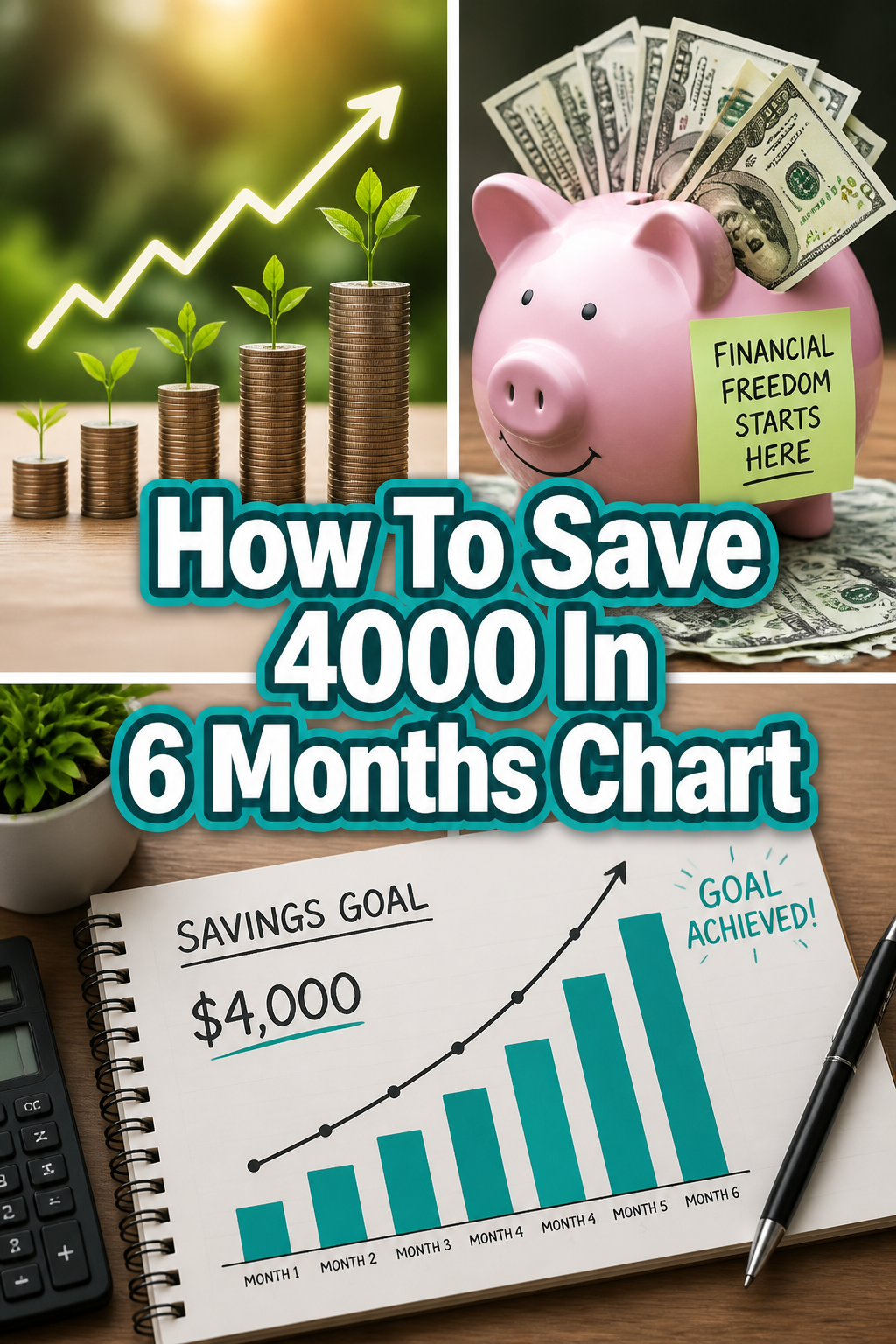
Saving $4000 in six months sounds like a lot, but it’s much less intimidating when you break it into smaller, manageable chunks. This is where the “chart” idea comes in – creating a visual roadmap.
Calculate your monthly savings target: $4000 / 6 months = approximately $667 per month. That’s about $167 each week.
Create a simple savings chart for yourself. You can draw a grid, use a spreadsheet, or download a printable tracker. Mark off each $100 or $50 increment as you save it, making your progress visible and motivating.
Step 3: Craft a Zero-Based Budget (or a Tight 50/30/20)
A budget is your spending plan. For aggressive saving, a zero-based budget is powerful, where every dollar has a job. Alternatively, a strict 50/30/20 budget can work if you adjust the percentages.
Assign every dollar of your income to a category: fixed expenses, variable expenses, debt repayment, and savings. In a zero-based budget, your income minus all expenses and savings should equal zero.
Allocate at least $667 to your “Savings” category each month. If your current spending doesn’t allow for this, you need to find areas to cut, which leads us to the next step.
Pro Tip: For a 50/30/20 budget, aim to shift more towards savings. Maybe 50% needs, 20% wants, and 30% savings for this goal. Adjust as necessary to hit your $667 monthly target.
Step 4: Slash Unnecessary Spending with Precision
This is where the rubber meets the road. Go through your variable expenses with a fine-tooth comb and identify non-essentials you can temporarily cut or significantly reduce.
Cancel unused subscriptions: streaming services, gym memberships you don’t use, software you forgot about. These small monthly fees add up quickly.
Reduce dining out and takeout. Eating at home is almost always cheaper. Pack lunches, cook in bulk, and plan your meals to avoid impulse food purchases.
Limit impulse buys and discretionary spending. Before buying anything non-essential, implement a 24-hour rule. Often, the urge passes.
Step 5: Boost Your Income, Even a Little Bit
While cutting expenses is vital, increasing your income can accelerate your savings dramatically. Even small extra amounts add up fast over six months.
Consider a side hustle. This could be anything from freelancing in your area of expertise, dog walking, babysitting, or delivering food.
Sell unused items around your home. Clothes, electronics, furniture, books – decluttering can put significant cash directly into your savings.
Ask for extra shifts at work if possible. Even an extra few hours a week can contribute meaningfully to your $667 monthly goal.
Step 6: Automate Your Savings for Consistency
Make saving non-negotiable by setting up automatic transfers. This removes the temptation to spend the money before you save it.
Set up an automatic transfer of $667 from your checking account to a separate savings account on payday. Treat this transfer like any other bill.
Open a high-yield savings account if you don’t have one already. Your money can earn a little extra while it sits there, which is a nice bonus.
Pro Tip: Name your savings account something motivating, like “Trip to Italy Fund” or “Future Freedom Account.” This personalizes your goal and keeps you focused.
Step 7: Track Your Progress and Celebrate Milestones
Seeing your savings grow is incredibly motivating. Regularly check your progress against your chart and acknowledge your hard work.
Update your savings chart weekly or bi-weekly. Color in a square, mark a line, or update your spreadsheet. This visual feedback is powerful.
Reward yourself for hitting smaller milestones (e.g., $1000 saved). These rewards should be small, free, or very low-cost, like a long walk in nature, a movie night at home, or a special home-cooked meal.
Step 8: Maintain a Money-Smart Mindset
Your mindset plays a huge role in your financial success. Cultivate a positive and proactive attitude towards money.
Practice gratitude for what you have. This helps combat feelings of scarcity or deprivation when you’re cutting back.
Educate yourself about personal finance. Read books, listen to podcasts, or follow money-smart blogs. The more you learn, the more confident you’ll become.
Common Mistakes to Avoid
Being Too Restrictive
Trying to cut every single enjoyable expense can lead to burnout and giving up. It’s important to leave a little room for “fun” money, even if it’s a small amount. A completely unsustainable budget will inevitably fail.
Instead, aim for sustainable cuts that you can stick with for six months. Allow yourself a small, pre-budgeted treat now and then to keep your spirits up and avoid feeling deprived.
Not Tracking Your Spending
Many people create a budget but then fail to track if they’re actually sticking to it. This makes the budget useless. Without tracking, you won’t know where your money is truly going or if you’re overspending in certain categories.
Make it a habit to check your spending daily or every few days. Use an app, a spreadsheet, or even a small notebook to log every expense. This constant awareness is key to staying on track.
Ignoring Income-Boosting Opportunities
Focusing solely on cutting expenses can feel limiting. While essential, it only addresses one side of the equation. Many people overlook their potential to earn more, which can significantly speed up their savings.
Actively look for ways to increase your income, even temporarily. Selling items, picking up extra work, or even negotiating a small raise can make a huge difference in reaching your $4000 goal faster.
Giving Up After a Slip-Up
No one is perfect, and you will likely have moments where you overspend or miss a savings target. The biggest mistake is letting one slip-up derail your entire plan. This is a marathon, not a sprint.
If you make a mistake, acknowledge it, learn from it, and get right back on track the next day or week. Don’t let perfection be the enemy of progress. Adjust your plan if needed and keep moving forward.
Troubleshooting
My Budget Feels Too Tight
If your budget leaves you feeling constantly deprived, it might be too aggressive. While this goal requires discipline, it shouldn’t make you miserable. Revisit your expenses.
Look for areas where you can make small, sustainable cuts rather than drastic ones. Perhaps you can reduce dining out from three times a week to once, instead of eliminating it entirely. Also, focus on income-boosting methods to ease the pressure on your spending.
I Had an Unexpected Expense
Life happens, and unexpected costs like car repairs or medical bills can throw a wrench in your savings plan. Don’t panic or give up. This is a temporary setback, not a failure.
Adjust your savings target for the current month, or temporarily pause your automatic transfer if absolutely necessary. The important thing is to get back on track as soon as you can. Consider building a small emergency fund alongside your $4000 goal for future peace of mind.
My Motivation is Waning
Saving money can feel like a long slog, and it’s normal for motivation to dip. When you feel discouraged, remind yourself why you started this journey. Revisit your savings chart and see how far you’ve come.
Talk to a supportive friend or family member about your goals. Read inspiring financial stories. Sometimes, a fresh perspective or a reminder of your “why” is all you need to rekindle your drive.
Key Takeaways
- Know Your Numbers: Understand your income and expenses intimately to create an effective plan.
- Break Down Your Goal: Divide $4000 into monthly ($667) and weekly ($167) targets to make it manageable.
- Budget Aggressively: Use a zero-based or tight 50/30/20 budget to ensure every dollar has a purpose, prioritizing savings.
- Cut & Boost: Actively reduce non-essential spending while seeking opportunities to increase your income.
- Automate & Track: Set up automatic transfers to a separate savings account and regularly monitor your progress to stay motivated.
- Maintain a Positive Mindset: Embrace discipline, learn from setbacks, and celebrate milestones to sustain your efforts.
Frequently Asked Questions
Is saving $4000 in 6 months realistic for everyone?
It’s a challenging but achievable goal for many, especially with focused effort on both cutting expenses and increasing income. However, it depends heavily on your current income, expenses, and financial obligations. For some, it might require significant lifestyle changes, while for others, it’s more straightforward.
What if I can’t save the full $667 every month?
Don’t get discouraged! Even saving a portion of that amount is still progress. Re-evaluate your budget for additional cuts, explore more income-boosting options, or consider extending your timeline slightly. Any amount saved is a win.
Should I prioritize paying off debt or saving for this goal?
This depends on the type of debt. High-interest debt (like credit card debt) often costs you more in interest than you’d earn in a savings account. It’s usually wise to prioritize tackling high-interest debt first. For lower-interest debts, you might balance both saving and debt repayment, or focus on one at a time.
What kind of savings account should I use?
A high-yield online savings account is generally recommended. These accounts typically offer better interest rates than traditional brick-and-mortar banks, allowing your money to grow a little faster. Look for one with no monthly fees and easy transfer options.
Our Top Recommended Finds
- Budgeting App (e.g., YNAB, Mint): Helps you track spending, categorize expenses, and visualize your budget in real-time.
- Savings Challenge Tracker Printable: A visual chart or printable template you can color in as you hit savings milestones, keeping you motivated.
- “The Total Money Makeover” by Dave Ramsey: A popular book that provides a step-by-step plan for financial stability, including aggressive saving and debt repayment.
Your Financial Journey Starts Today
You now have a clear roadmap to save $4000 in the next six months. This isn’t just about hitting a number; it’s about building financial muscle, gaining confidence, and proving to yourself what you’re capable of. The power to change your financial future is truly in your hands.
Imagine the freedom that $4000 could bring – whether it’s for an emergency fund, a down payment, or a much-deserved experience. Don’t wait for the “perfect” moment. Take that first step, calculate your numbers, and commit to your savings chart today. Your future self will thank you.